
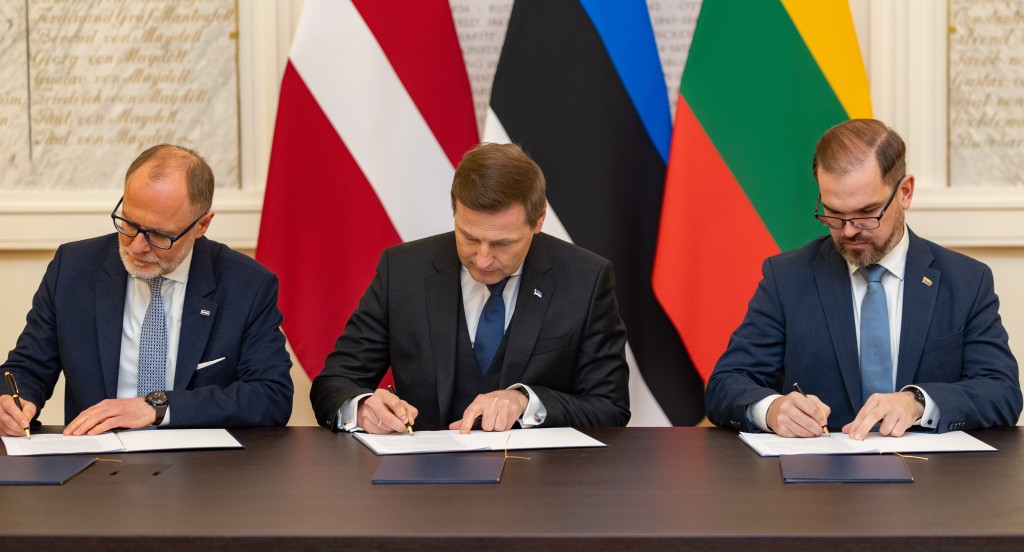
The aim in establishing an MMA is to harmonise peacetime border crossings and movement and transport procedures. The end result of creating MMAs will be the establishment of a harmonised area across Europe.
Estonian Minister of Defence Hanno Pevkur says that as befits close neighbours, Estonia’s cooperation with Latvia and Lithuania is strong. “In order to deepen that cooperation, my fellow defence ministers and I have decided to establish a Baltic Military Mobility Area, which will allow our defence forces to move military equipment on a common, standardised basis,” he explained. “This is important in strengthening our defence posture, with the ultimate goal being to create a ‘military Schengen zone’ across Europe.”
Latvian Minister of Defence Andris Sprūds says the three Baltic States have the desire to work together that is needed for defence cooperation. “Our security is only as strong as our will to act,” he remarked. “The Baltic Defence Line and industrial cooperation are our responsibility, and a practical response to regional challenges. By synchronizing our forces, we are not only strengthening the NATO border but also creating a lasting foundation of stability for all of Europe.”
Lithuanian Minister of Defence Robertas Kaunas described the letter of intent signed today for the formation of a Baltic Military Mobility Area. “It means that, when necessary, Lithuanian military equipment can move freely to defend Riga, Estonian artillery can support Vilnius, Latvian forces can lend their strength to Tallinn and vice versa, with each nation’s capabilities seamlessly supporting the others,” he said. “In times of crisis, every hour matters – bureaucratic borders cannot slow down our defence. The Baltic States will never again be anybody’s backyard. We are the guardians of NATO’s eastern flank, and we take that responsibility seriously.”
According to the three ministers, the Baltic Defence Line has evolved into a modern, cross-domain defence concept.
“Estonia’s focus will be on completing the construction of bases, barriers and storage sites,” Minister Pevkur explained. “To date, all primary containment equipment has been delivered and stored. We have selected a standard bunker and tested it in the south-eastern part of the country, with a view to launching a major call for tenders this year. We will also continue to build a significant number of containment ditches in 2026. The Defence Line has become an essential element in ensuring the security of the eastern flank of NATO and the EU.”
In addition, capacity upgrades to meet the goals of NATO forces through joint procurements and with the help of the European Union’s SAFE Loan Instrument were discussed. For example, Estonia and Latvia have acquired Piorun short-range and IRIS-T medium-range air defence systems, deliveries of which will start in 2026. The Baltic States have also cooperated to develop deep-strike capabilities with HIMARS rocket launchers, which the Estonian Defence Forces received and put into service in 2025. Estonia and Lithuania also form part of a group of countries that have decided to intensify cooperation for the development and possible future procurement of next-generation CV90 combat vehicles.
The cooperation format of Baltic defence ministers was presided over by Estonia in 2025, with Latvia taking over the role in 2026.
