Minister of Defence Herem: next year, we will focus on strengthening existing capabilities as well as developing new ones
Under the draft 2027 state budget approved by the Government of the Republic, a significant share of next year’s defence budget will go towards replenishing ammunition stocks, while investment in new capabilities will focus on developing a layered air defence system. Defence expenditure will amount to 5 per cent of GDP in 2027.
“Developing a layered air defence system is already a course we have been pursuing in recent years. The main change now is that we are moving towards a more comprehensive approach to air defence, including capabilities for which we have largely relied on our Allies in the past. This is a major undertaking that will not be completed next year. However, the sooner we take the necessary steps, the sooner we will be able to provide significantly stronger air defence,” said Minister of Defence Martin Herem. “The faster the Estonian Defence Forces can respond to aerial threats and protect critical infrastructure, the less disruption attacks will cause to society as a whole in the event of a military threat,” he added.
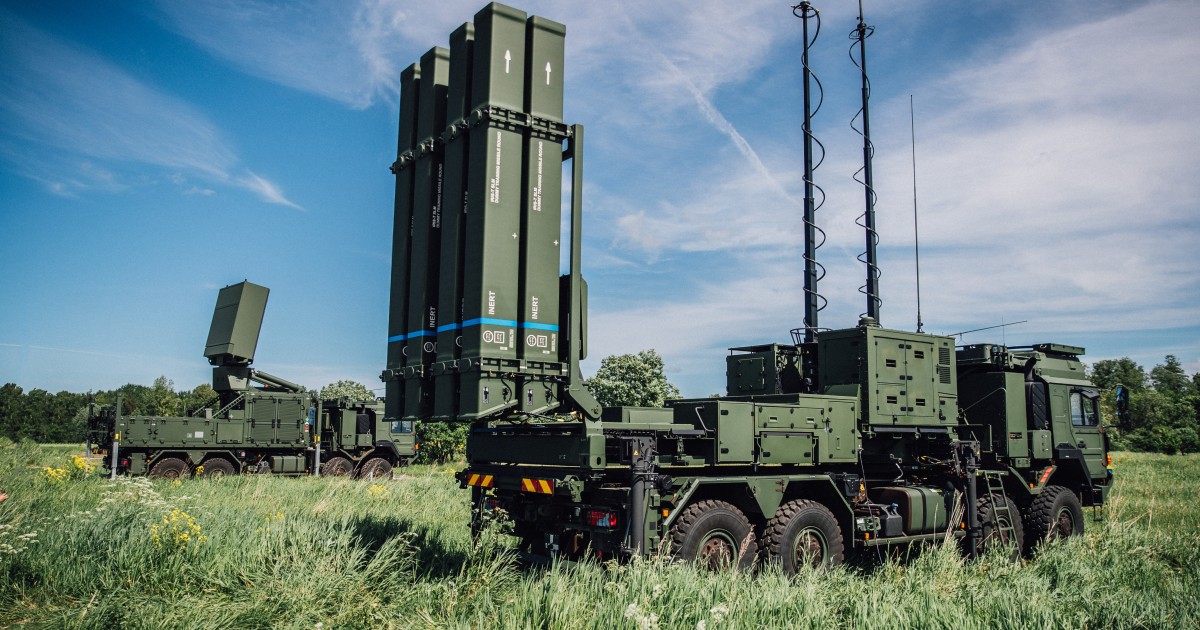
Next year, €40.6 million will be allocated to developing air defence, including strengthening air surveillance capabilities. The layered air defence system will comprise Piorun and Mistral short-range systems and the IRIS-T SLM medium-range system. Estonia has acquired Piorun and Mistral systems in recent years. This year, the Estonian Defence Forces began introducing the IRIS-T SLM medium-range air defence capability. The next steps will be to further develop air surveillance and air operations command and control, while preparing to establish longer-range air and missile defence capabilities.
A major focus will also be on replenishing ammunition stocks for air and missile defence, deep-strike capabilities, indirect fire, anti-tank capabilities and unit-level combat operations. Particular attention will be paid to ammunition for unmanned systems and loitering munitions, with €632 million allocated for procurement.
“The same principle applies to unmanned systems. The Estonian Defence Forces must have a clear understanding of which drones they need and how to use them in combat, while Estonia’s defence industry must be able to deliver suitable solutions that can be developed rapidly. We need unmanned systems for reconnaissance and surveillance, target acquisition and fire control, as well as for engaging and disrupting adversary forces. These capabilities must be interconnected and integrated with our other military capabilities. That is why drone capabilities must be developed across all branches of the armed forces,” Herem said. A total of €100 million will be allocated in 2027 to developing unmanned systems capabilities.
A further €12 million will be allocated next year to improving force protection, freedom of action and defence readiness, including continuing work on the Baltic Defence Line. The aim is to strengthen the ability to disrupt adversary operations while protecting friendly forces and enabling them to manoeuvre. The defensive line will help channel defensive operations into prepared areas and minimise the impact of military activities on populated areas and critical infrastructure.
Next year, €5.3 million will be allocated to developing naval capabilities, including coastal patrol and force protection capabilities. Underwater surveillance will also be enhanced to improve maritime situational awareness and the ability to detect underwater activity.