
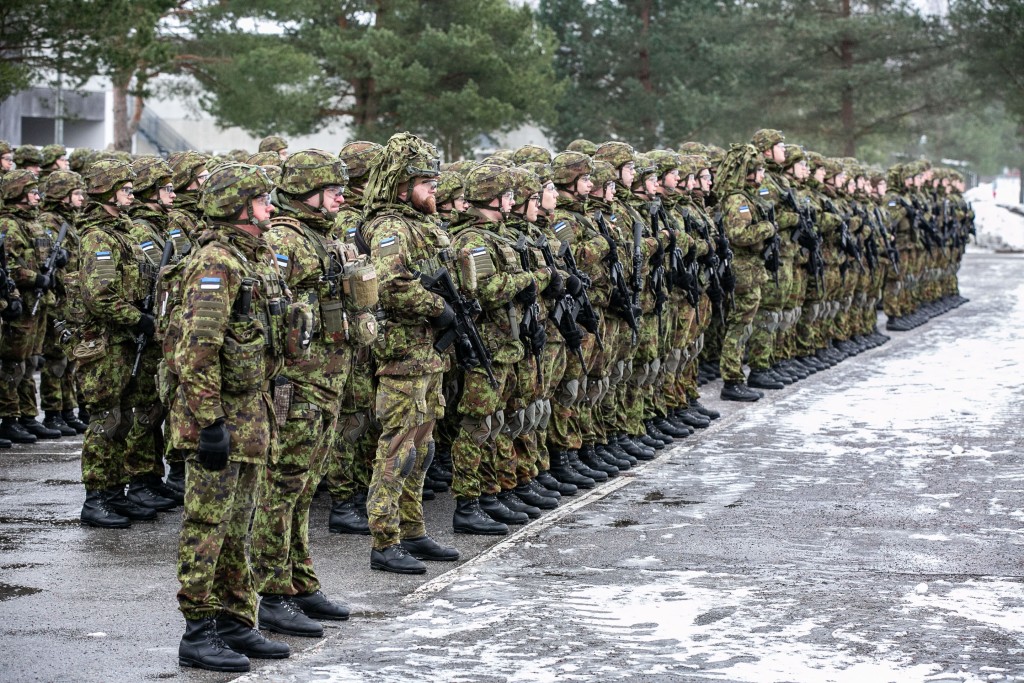
From 2027 onwards, the usual number of conscripts, i.e. up to 4,100 draftees per year, will once again be called up for conscript service. In addition, a uniform 12-month service period will be introduced for all conscripts, and draftees will be called up for military service twice a year (in weeks 8 and 34) instead of the current three times.
‘Due to the security situation, we have significantly developed Estonia’s defence capabilities in recent years. We have also already acquired, and are still acquiring, notable new capabilities, such as rocket launchers and medium-range air defence, which require the Estonian Defence Forces to adapt their training and improve quality. To this end, we will focus on training instructors of the Estonian Defence Forces in 2026 so that we can launch the renewed conscription system at the beginning of 2027. As a result, the overall combat readiness of the Defence Forces and their ability to defend the Estonian state will increase,’ said Minister of Defence Pevkur.
‘Considering the complexity of the new capabilities of the Estonian Defence Forces, changes in the security situation, and conclusions drawn from the war in Ukraine, we also need to adapt the training and service of our soldiers. One feature of these changes is extending the service length of all conscripts to 12 months and, in the course of this, establishing a period of constant combat readiness as part of service practice,’ said Lieutenant General Andrus Merilo, Commander of the Estonian Defence Forces. ‘Our new high-tech capabilities require soldiers to act with skill, speed, and precision in assessing situations, communicating information, operating equipment, and making decisions. Six months of intensive training must lay the groundwork for operating weapons systems, and the following six months of practice must simultaneously ensure both the constant readiness of the systems and the increase in proficiency.’
The period where the unit is in constant combat readiness will essentially be a service practice during which soldiers repeatedly rehearse performing military tasks to increase their skills and gain experience. At the same time, establishing such period allows some of the new weapon systems to be kept on permanent standby to respond to potential military threats against Estonia.
According to Anu Rannaveski, Director General of the Estonian Defence Resources Agency, the twice-a-year call-up system will enable the smoother planning of conscription and a more even distribution of conscripts across the service. ‘This gives us better opportunities to ensure that the Defence Forces have people with the education and skills required for different specialities, and to utilise the potential of each draftee in a more targeted manner,’ added Rannaveski.
According to the Estonian Defence Forces, these changes are inevitable, as the scope and technical complexity of training have increased significantly in recent years, and the security situation requires maintaining several new capabilities in a state of constant combat readiness. Without changing the structure of military service, it would not be feasible to ensure an increase in overall capability or response speed.
In the coming years, the Estonian Defence Forces will acquire several high-level weapon systems, including medium-range air defence and other sensitive capabilities that require competent and systematically trained operators. Most of the skills required for this are acquired during military service.
A uniform 12-month service ensures that conscripts undergo six months of intensive general and specialist training, followed by six months of sustaining constant combat readiness as a practical component, during which their skills are continuously improved. This structure ensures the necessary depth and consistent quality of training in all specialities, resulting in even stronger defence forces.
So far, most conscripts have served for 11 months, with a smaller proportion serving 8 months. These periods of service will be replaced by a single 12-month period of service from 2027. The changes will create a better prepared, more stable, and more consistent wartime structure for the Estonian Defence Forces, which meets the technical and tactical requirements of modern national defence.
Additional information: [email protected]
